
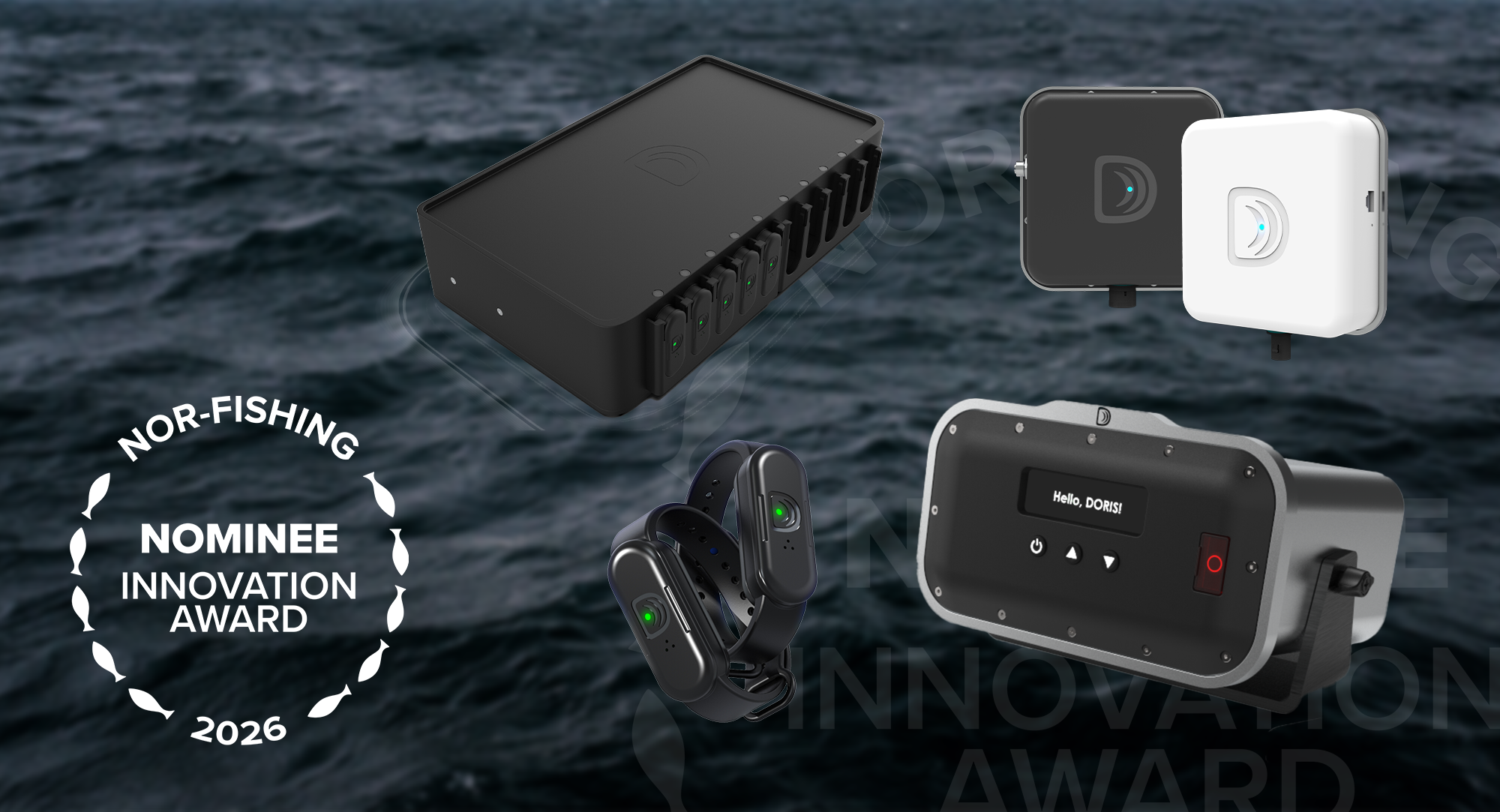
Innovation Award: Designed to prevent loss of life at sea
With a maritime safety platform built around wristbands and a dedicated communication system tailored for steel environments, Dimeq gives crew and shipowners real-time oversight during emergencies – and automatic alerts the moment an accident occurs.
The goal is as clear as it is important: saving lives at sea.
— The platform is an addition to the technology used today. The system detects man-overboard incidents and provides real-time information on the crew’s location during an emergency. It also gathers data that can be used to prevent accidents in the future, says Ronny Bakke, CEO and co-founder of Dimeq.
Nominated for the Innovation Award 2026
For the development of its maritime safety platform, Dimeq has been nominated for the Innovation Award, presented during Nor-Fishing 2026.
— Our solution covers the safety needs of large vessels, aquaculture facilities and smaller fishing boats, says Bakke.
Dimeq is nominated for the Innovation Award alongside Marine Hybrid Solutions and Hoseth Technology. For more information about the solution, arrange a meeting with Ronny Bakke.
Safety on the wrist – 24 hours a day
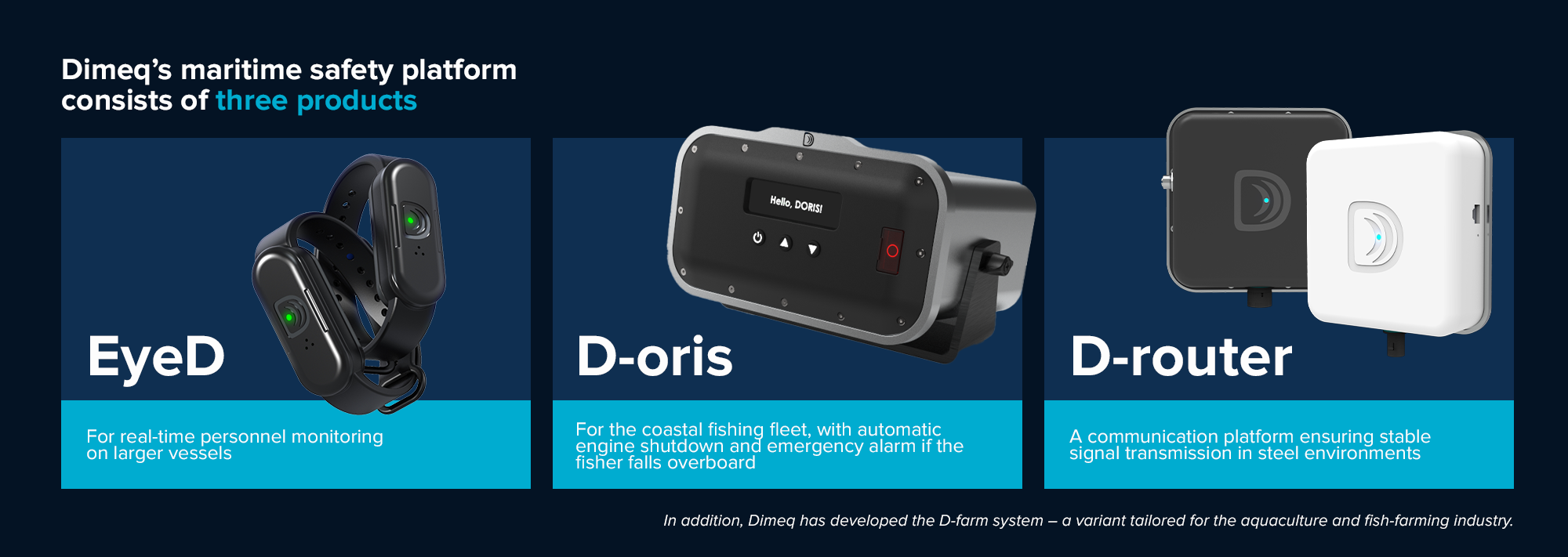
At the heart of the safety solution is EyeD – a sensor-based wristband worn by the crew. It detects falls, automatically triggers a man-overboard alarm, and includes a panic button that can be activated manually. When an alarm is triggered, the wristbands give the captain real-time oversight of everyone’s location on board, with zone control and alerts if anyone is in a high-risk area.
An important differentiation from other safety systems is that the wristband is worn around the clock – including off-duty. Conventional safety systems typically cover only work situations, but accidents can happen just as easily during a crew member’s free time.
— My own experiences with emergencies at sea happened off duty. With EyeD on the wrist, you get an extra layer of safety on board, says Bakke.
He also stresses that the system is not used to monitor how the crew carry out their work. Positioning data is used solely for safety purposes – such as zone control and man-overboard detection – and is made available to the captain during emergency and high-risk situations.
A stable communication platform for steel environments
To understand what sets Dimeq’s system apart from other solutions, we need to look more closely at the network it’s built on – the D-router communication platform. In maritime and steel environments, where signal strength and stable connectivity can be a challenge, D-router uses the vessel’s electrical grid to create a wireless mesh network. This ensures stable connectivity throughout the vessel, and that alarms work as they should.
D-router also communicates between servers and routers via Ethernet, and functions as an IoT hub to which a range of sensors and signal components can be connected. This means shipowners avoid having to operate multiple separate systems, simplifying the entire network installation on board.
The entire HSE ecosystem in one platform
With Dimeq’s system, crew and shipowners get a single platform that covers the full scope of their safety needs. Feedback from the industry shows that today’s vest-based systems with separate radios are often in the way during work and require a lot of maintenance. Dimeq was conscious of this from the outset.
— Early in development, we were focused on ensuring that the wristbands wouldn’t get in the way of the crew, whether at work or off duty. They had to be small, and comfortable enough to be worn hour after hour without being noticed – and we’ve achieved that, says Bakke.
The same technology also works across vessels, fish farms and service boats. If all areas are set up with the system, the crew can move freely between service boats, cages and well boat – while always remaining within the same “safety umbrella”.
Already in use at sea
The safety platform is already in operational use. The fishing vessel Vestfart has taken part in testing since 2022 and became Dimeq’s first paying customer earlier this year. According to Bakke, the system has performed reliably throughout the entire test period.
In addition, seismic survey company TGS has been a pilot customer since 2018.
Single-handed boats and smarter boatbuilding
While the solution for larger vessels and fish farmers is being rolled out to the market, Dimeq is working on D-oris – a variant tailored for single-handed boats and the rest of the coastal fishing fleet.
— The prototype was tested in December with good results, and the product is now on its way to market, Bakke concludes.
The winner of the Innovation Award 2026 will be announced during the opening ceremony of Nor-Fishing, Tuesday 18 August, 11:30 – 12:20, in the Mendelsohn conference hall, Trondheim Spektrum.