
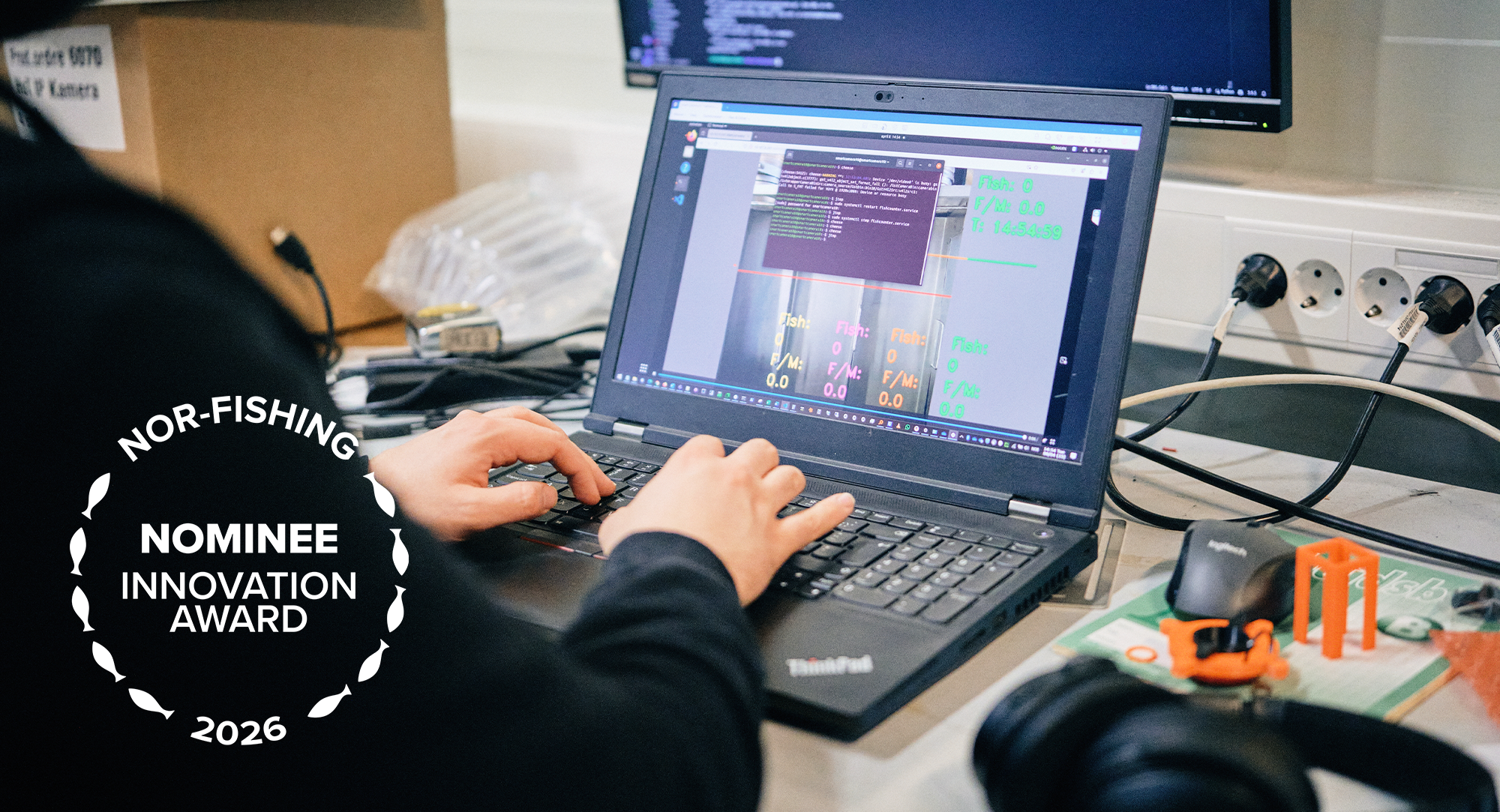
Innovation Award: Controlling the production line with an intelligent AI camera system
Flow A.I. from Hoseth Technology is an AI-based camera system that monitors and controls fish flow at harvesting and processing plants in the seafood industry. The system detects bottlenecks before they can cause backups on the production line.
The result is a more even production flow, reduced waste, better raw material utilisation and increased capacity – while giving operators a more predictable working day. Preliminary tests from several different facilities show yield improvements of 10–15 percent.
— The system always delivers the right number of fish into the production line, adapting delivery to the available capacity at each stage. At the same time, we see that operators are more satisfied when production adapts to them and their workflow, rather than the other way around, says Klaus Hoseth, CEO of Hoseth Technology.
Nominated for the Innovation Award 2026
For the development of the control system Flow A.I., Hoseth Technology has been nominated for the Innovation Award, presented at Nor-Fishing 2026. The system was developed by Vebjørn Bjørlo-Larsen, a developer at Hoseth Technology. It builds on work from his bachelor’s and master’s theses – which the CEO finds particularly rewarding.
— I jumped out of my chair when I got the email saying we’d been nominated; it confirms we’re on the right track. It’s especially rewarding that a student project has grown into a tool that can benefit the entire industry, says Hoseth.
Hoseth Technology is nominated for the Innovation Award alongside Dimeq and Marine Hybrid Solutions. For more information about the solution, book a meeting with project manager Eirik Kanck.
Ceiling-mounted cameras control the production flow
Hoseth Technology mounts cameras along the ceiling in the factories and trains the system to interpret the images using artificial intelligence. The camera system follows the flow of fish throughout the entire facility – starting when the live fish are counted into holding tanks, through the bleeding tank, unloading, and onto buffer tables.
The cameras are freely mounted in the ceiling, interfere minimally with the actual production, and can be set up in old and new factories alike.
— We recently installed the system with nine cameras at a cod facility. The system converts what the cameras see into data, which is used to continuously regulate speed and feed rate on the conveyor, explains developer Bjørlo-Larsen.
One camera – multiple tasks
Part of what sets Flow A.I. apart from other camera systems is that each individual camera can handle several tasks simultaneously.
— Each camera can extract far more information than just counting fish. The norm has been one camera, one task – with our system, we solve multiple tasks with the same camera, says Hoseth.
Using data from the same camera, the system can, for example, register how many fish are in each production zone, track the pace of the production flow, and detect anomalies – such as fish ending up on the floor or activated warning lights.
Machine learning and bespoke configuration
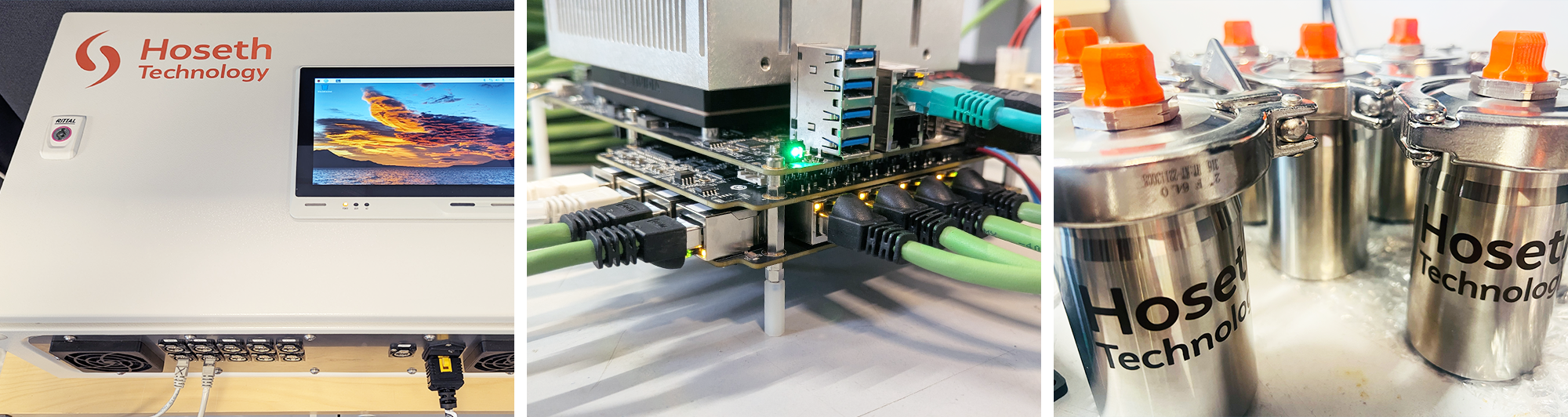
The models behind Flow A.I. are trained centrally at Hoseth Technology, using large volumes of images. The system is fully trained by the time it’s put into operation at a customer’s site.
— We use machine learning and train the model before it’s put into use. Once it’s fully trained, when we connect the cameras at the factory, the model recognises what it’s looking at, says Hoseth.
He also points out that while the training is shared across all facilities, the configuration is site specific. All data collected by the system is made available on an open protocol, so that other systems and operators throughout the customer’s production can make use of it.
A better working environment for operators
Just as important as the flow of the production line is how the system affects the people on the floor. In the past, a stop on the line could mean fish overflowing and operators having to shout to alert one another. With Flow A.I., the line adapts to the operator’s pace – even when someone steps away from their station.
— The goal is for operators to feel seen but not watched. The cameras film the work situation and adapt to it, but they’re not focused on the operators themselves, Hoseth promises.
From salmon farming to the fishing fleet
Flow A.I. project manager Eirik Kanck explains that the solution is currently delivered to both land-based facilities in the salmon industry and vessels. Hoseth Technology is now turning its attention to the fisheries industry.
— Flow A.I. has been tested by several major fish farmers, including Mowi, Lerøy, SalMar, Cermaq and Camanchaca. The technology is in use on salmon in Chile, Canada, Iceland, Norway and Australia, he says, continuing:
— Whilst farmed salmon is uniform and consistent, wild-caught whitefish varies a lot more. The catch varies in size and quality, often consisting of several species mixed together. That makes it even more valuable that the system can recognise the species – for example distinguishing saithe from cod – estimate size, and detect wounds, cutting errors or incorrectly filleted fish and sort those fish out, Kanck explains.
The whitefish industry also faces a challenge that salmon harvesting plants don’t: today, almost all fish are frozen at sea and must be thawed before processing. This process can also be controlled using cameras, something Hoseth Technology will be showcasing at stand F-585 during Nor-Fishing.
— We believe our solution is a major step in the right direction for modernising the industry. In the bigger picture, it’s about optimising traceability, food safety and animal welfare in the fisheries industry, Kanck concludes.
The winner of the Innovation Award 2026 will be announced during the opening ceremony of Nor-Fishing, Tuesday 18 August, 11:30 – 12:20, in the Mendelsohn conference hall, Trondheim Spektrum.