
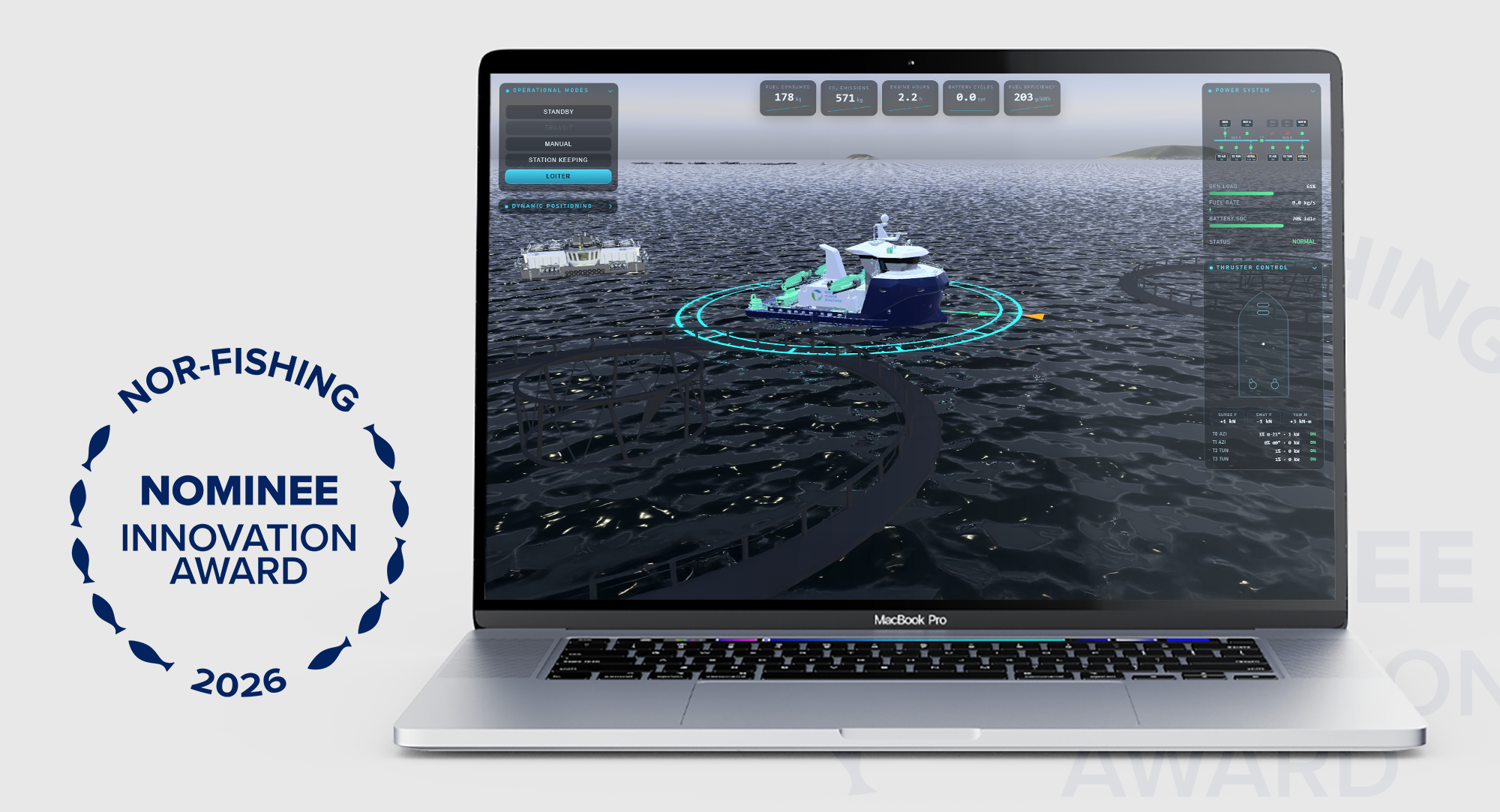
Innovation Award: Lets shipowners test power systems virtually – before making decisions
In the Miira platform from Marine Hybrid Solutions, shipowners can simulate and test hybrid power systems for vessels in a virtual model – before making major investment decisions.
The simulation calculates fuel consumption, emissions, battery performance and energy reserves, among other things – and lets users explore the consequences of different choices for themselves.
— Miira Lab allows shipowners to bring hard-won operational experience into the early design and advisory phase. Through simulation, what might otherwise become future challenges is uncovered and resolved, says Jonas Læret, CTO of Marine Hybrid Solutions.
Nominated for the Innovation Award 2026
For the development of the simulation tool Miira Lab, Marine Hybrid Solutions has been nominated for the Innovation Award, presented during Nor-Fishing 2026.
— The nomination is a recognition that we have identified a need in the market and developed a strong solution that creates value for shipowners, says Thea Marie Wien Alvik, CMO of Marine Hybrid Solutions.
Marine Hybrid Solutions is nominated for the Innovation Award alongside Dimeq and Hoseth Technology. For more information about the solution, schedule a meeting with Thea Alvik or Jonas Læret.
Test the vessel in an interactive model
Today, there is often considerable uncertainty surrounding important choices about electrical power systems – choices that must be made in the early design phase, both in newbuild projects and when upgrading vessels. As a result, many shipowners make decisions involving significant financial risk, without knowing whether those choices will actually deliver savings over time.
With Miira Lab, the risk in the investment phase is reduced significantly, because the shipowner can see how the choices made affect operations over time.
In the interactive vessel model, shipowners can explore a range of “what if” scenarios for themselves – such as lowering battery capacity, adjusting the diesel engines or changing the architecture of the power system. Simulations then show how those choices affect fuel consumption, energy reserves, battery cycles, wear, service life and emissions, among other things.
— Rather than receiving the information in an analysis report, the customer is given the opportunity to experiment in an interactive model themselves, says Læret.

Make the right choices throughout the entire life cycle
The vessel models created in Miira Lab live on after the vessel enters operation.
When do you charge the batteries, and when do you draw energy from them? What is the right sailing speed to minimise wear, while still arriving when you need to? When do you start the diesel engines, and how many? These are typical questions that the virtual model can answer.
— The crew on board has one chance, one opportunity to make the right choice in the moment. Virtually, we can simulate thousands of choices and situations and then tell the crew what the best choices actually are, explains Læret.
He also points out that every choice is a trade-off between fuel consumption, energy consumption and wear on engines and electrical systems. That trade-off has not been visible before.

Simpler optimisation of operations
A very concrete example of how the applications in the Miira platform contribute to more efficient operations is the ability it gives shipowners to optimise operating patterns not only at vessel level, but also at group and fleet level.
A fleet manager onshore will be able to see that one vessel will reach 20,000 operating hours on its diesel engines next year, while its batteries will reach the end of their service life this year. The power systems can then be run in such a way going forward that the need for servicing arises at the same time, allowing one complete yard stay to be scheduled instead of two separate ones.
— By actively managing the assets in the fleet – based on actual data and impact assessments – shipowners can ensure that several vessels do not need servicing at the same time, and that operational capacity is always available, says Læret.
Excellent response from the market
The maritime industry has already embraced Marine Hybrid Solutions’ solution. Both Læret and Alvik are seeing strong interest – whilst also meeting shipowners who are grappling with far greater uncertainties than one might expect.
— Shipowners we talk to are wondering whether they should have battery packs that are 50% larger or 50% smaller. That says something about the scale of uncertainty shipowners live with today. It also shows the enormous need for more data on how hybrid power systems operate – which they now get, Læret concludes.
The winner of the Innovation Award 2026 will be announced during the opening ceremony of Nor-Fishing, Tuesday 18 August, 11:30 – 12:20, in the Mendelsohn conference hall, Trondheim Spektrum.